
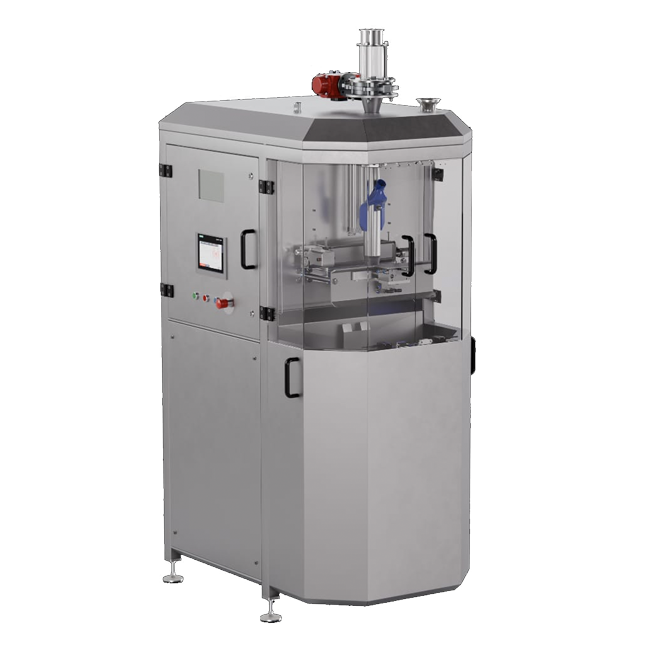
Inline Packing & Coding System
Close the quality loop
What you can prove, packaged and coded from the production line to inspection.
Automated sample collection, retention packaging, and direct batch coding. Every sample packaged, coded, and archived from the production line to inspection without a single manual step. No loose labels. No paperwork. No gaps in your traceability chain.
Automated sample collection and retention packaging
Direct batch coding — data printed on the bag, no labels required
Full audit trail — every batch traceable from production to inspection
Sample > Pack > Code > Document
The Inline Packing & Coding System handles the complete retention sampling workflow in a single, unmanned system. It operates from standby mode to final discharge without any operator involvement.
SAMPLE
Automated sample collection from the production process. The system interfaces with the factory automation environment. Samples are delivered to the packaging unit without manual handling.
PACK
The sample is packaged automatically into a retention bag. The system operates from standby mode through to packaging without operator presence, handling the full process cycle autonomously.
CODE
An integrated printer codes the bag directly during packaging. Batch reference data (batch number, timestamp, product reference, or any required identifier) is printed onto the bag material. No label, no applicator, no separate process step. Traditional label-based systems can miss, mis-apply, or lose labels. Here, the code is the bag: permanent and inseparable from the sample.
DOCUMENT
The coded, packaged sample is discharged to the archive bin. The MES manages the packaging process and receives confirmation of each completed retention sample. Every batch is traceable: the coded physical sample and the MES record match.
The system that completes the quality chain.
PDI measurement confirms whether quality met the standard. Retention sampling proves it, with a physical sample that can be produced for any inspection, audit, or customer query. The Inline Packing & Coding System is designed to work alongside WEMO’s Inline PDI measurement systems, creating a complete, document-backed quality management workflow for every batch.
How the integrated workflow operates
Production line
Function in the quality chain > Pellets produced continuously on one or more pressing lines. Samples diverted to measurement and sampling systems.
Inline Kempink Tester or Ctrl
Function in the quality chain > Automated PDI measurement from the sample. Result communicated to MES. Ctrl additionally generates predictions and adjustment recommendations.
Inline Packing & Coding System
Function in the quality chain > Automated retention packaging of the sample. Direct coding of the bag. Coded sample discharged to archive bin. Confirmation logged in MES.
Complete batch record
The Inline Packing & Coding System can be deployed alongside the Inline Kempink Tester, the Inline Kempink Tester Ctrl, or as a standalone retention sampling solution where other quality measurement systems are already in place.
Audit-ready documentation for your sector’s requirements.
Retention sample documentation is a regulatory and commercial requirement across both primary sectors WEMO serves. The Inline Packing & Coding System automates what is otherwise a manual, error-prone process.

Animal Feed
Feed manufacturers operate under GMP+ B1 and GAFTA trade rules, both of which require documented retention samples as part of the quality management system. Manual retention sampling introduces the risk of missing samples, incorrect labeling, or inadequate batch references. Automated, coded retention packaging eliminates those risks and ensures the documentation exists for every batch, without depending on any individual operator.
GMP+ B1
Requires traceable quality documentation including retention samples. The Inline Packing & Coding System provides batch-coded physical retention samples that satisfy this requirement. Note: GMP+ certifies production environments, not individual instruments.
GAFTA
GAFTA trade rules require documented sample retention for internationally traded feed ingredients. Automated, coded packaging ensures every traded batch has a retrievable physical sample. Applies to animal feed sector only.
NVWA inspection
National food safety inspection authorities (such as the Dutch NVWA, the German BVL, or the UK FSA) may request production of specific batch samples during an inspection. Coded, archived retention samples provide the traceability basis for rapid response.

Wood pellets & biomass
Wood pellet producers operating under ENplus certification are required to maintain batch-level quality documentation. Since ENplus A1 requires a minimum mechanical durability of 98.0%, the ability to produce a physical retention sample traceable to a specific production batch is part of managing and demonstrating that compliance.
ENplus A1
ENplus certification requires traceable quality records for each production batch. Coded retention samples from the system provide the physical batch traceability that supports ENplus A1 compliance documentation.
ISO 17831-1:2025
Where ISO 17831-1:2025 PDI measurements are performed via the Inline Kempink Tester Ctrl or Ctrl+, the Packing & Coding System ensures a corresponding retention sample exists for every batch that was measured. Complete physical documentation to match the electronic record.

Part of your subscription to quality.
Like WEMO’s Inline measurement systems, the Packing & Coding System is delivered as Quality-as-a-Service. WEMO-techniek retains ownership of the hardware and full responsibility for performance. You pay a fixed monthly service fee and a one-time implementation cost. Subscribe standalone, or as part of a combined subscription with one or more Inline PDI measurement systems. A combined subscription covers the complete quality workflow (measurement, sampling, packaging, coding, and documentation) under a single monthly fee.
The quality data belongs to your operation. The technology and performance are WEMO’s responsibility.
What your operation gains from automated traceability.
Automated retention sampling changes more than the documentation process. It changes the reliability of the traceability chain and removes operational risk from the compliance picture.
Compliance without the effort
When retention samples are automated and coded at the point of production, documentation exists for every batch by default. Not because someone remembered to do it. GMP+, GAFTA, and ENplus requirements are met continuously, not reactively.
Labelling errors eliminated
Direct printing removes the label-related failure modes: missing labels, incorrectly applied labels, labels that detach in storage. The batch identifier is part of the bag itself. Traceability is permanent and inseparable from the physical sample.
Operator time freed for production
Automating retention sampling means operators are not required to interrupt production tasks to manage sample collection, packaging, and documentation. The system handles it.
Inspection response time reduced
When an inspection request arrives, the response is a coded bag retrieved from the archive, directly matching the electronic batch record in the MES. No search, no reconstruction, no gaps.
Logistics documentation strengthened
Coded retention samples create a complete physical paper trail that complements transport documentation. For internationally traded commodities under GAFTA, this physical traceability supports dispute resolution and quality claims management.